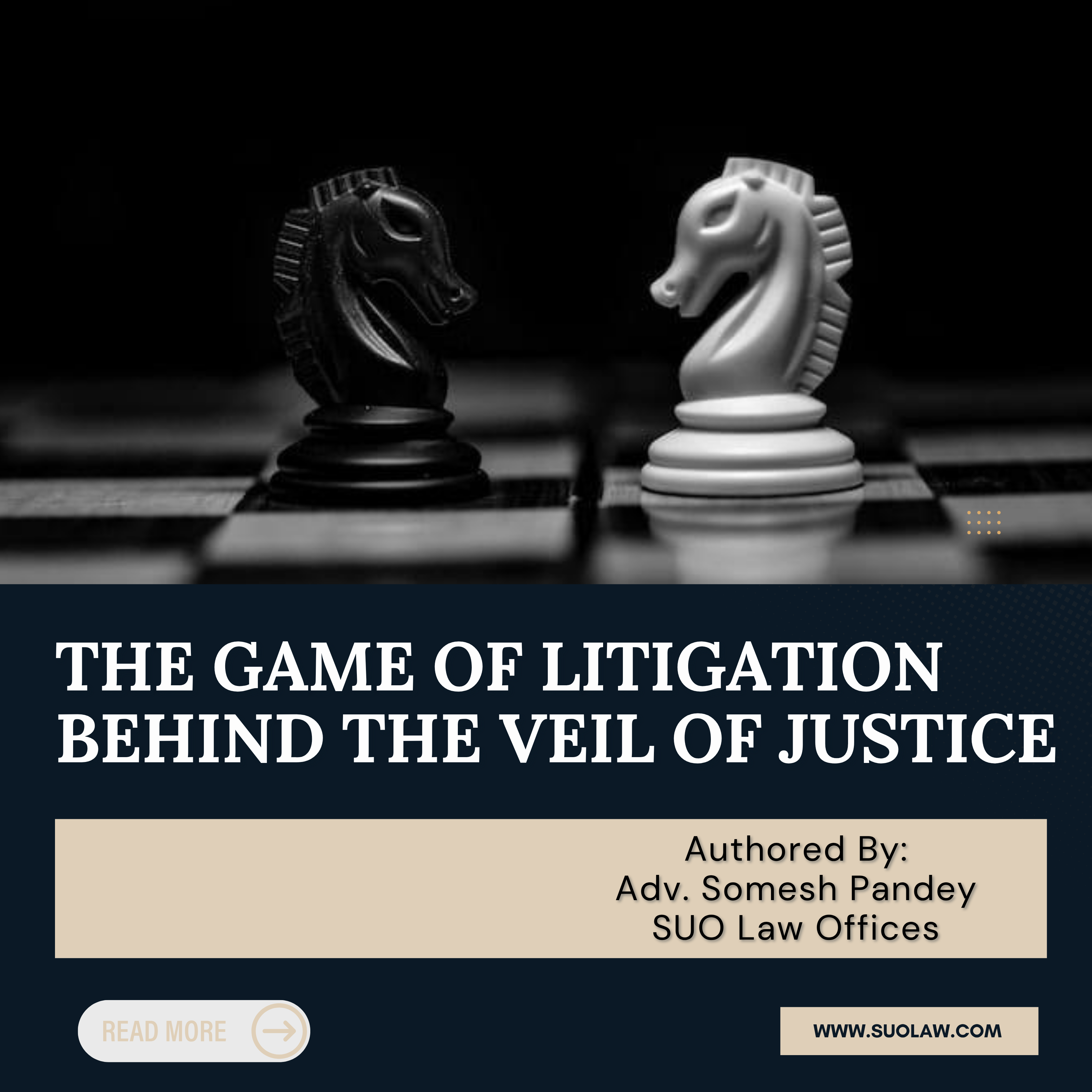
THE GAME OF LITIGATION BEHIND THE VEIL OF JUSTICE
Litigation is often idealised as a structured mechanism of formal grievance redressal, a system designed to uphold the rule of law, ensure due process, and deliver justice. On paper, it is governed by detailed procedural codes, evidentiary rules, and the solemn supervision of an independent judiciary. Yet those who live and breathe the system every day, advocates, judges, litigants, police officials, and court staff, know all too well that litigation is not merely a pursuit of justice, it is often a game that is strategic, unpredictable, and frequently tainted by interests extraneous to the cause of justice. At its noblest, litigation offers the promise of equality before law, a forum, where the privileged, poor, powerful and powerless may seek remedy. But this idea is frequently distorted by the very hands entrusted to protect it.
Abuse of process : a two way street
It is not uncommon to see the powerful and the wealthy to weaponize the process of law as a tool of vendetta. Frivolous and vexatious litigations are deployed to harass, impoverish, and exhaust an unsuspecting opponent, often someone lacking the resources and influence. A downtrodden individual may find itself trapped in a legal maze where the law is less a shield and more a sword drawn against it. This misuse of process is further compounded when legal procedures are intentionally misused to delay proceedings by filing successive interlocutory applications, seeking adjournments on untenable grounds, or dragging the matter to superior courts. In such cases, justice becomes not a right but a privilege attainable only by those who can afford the luxury of endless litigation.
Ironically, even the poor and marginalised, in whose name free legal aid is championed, can at times, misuse this support. Armed with state sponsor sponsored counsel and insulated from costs, false complaints or civil claims may be pursued, endlessly, not for justice, but as an instrument of vengeance or coercion. The system’s inefficiencies are laid bare when even meritless petitions are entertained for years before they are dismissed. Such abuse not only clogs the judicial pipeline but also casts suspicion over genuinely aggrieved litigants who are in actual need of legal recourse.
Then there are the ego wars, when two persons of means engage the system not for a redressal but for prestige. Here, the court becomes a stage for theatrics, where the goal is not resolution, but humiliation of other party. Resources are drained, dockets are clogged and yet no party truly seek closure. What makes such litigation particularly insidious is its performative nature. The courtroom becomes a symbolic battleground of status and power, where real issues are lost amidst procedural brinkmanship and high-pitched legal posturing. These cases, while appearing substantial on paper, often contribute nothing to jurisprudence but much to judicial fatigue.
The shadow state within the courtrooms
Beneath the black robes and wooden gavels lies another machinery that is the informal power structure of the court premises. In many courts, the ahlmads, stenographers and the peshkars wield influence disproportionate to their designation. Files are moved, buried and go missing on their discretion. They can determine listing dates, or even the chances of the matter being heard by a favourable bench. All this goes on without any consequence. The corridors of justice, thus are often policed not by law but by unofficial understandings.
This parallel ecosystem often thrives on patronage and gratuities. From the selective listing of cases to the informal fixing of court rosters, the administrative machinery becomes susceptible to influence. Junior advocates and litigants unfamiliar with this subterranean network are often left helpless, forced to rely on touts and agents to get the simplest procedural tasks completed.
Justice for sale
Public Prosecutors who are expected to represent the state with impartiality sometimes act as private counsel for the complainant skewing investigations and prosecutions. Conversely police officers tasked with enforcing the law have been known to shield the accused persons for a price, diluting the FIRs, misdirecting the evidence or soft pedalling arrests. The criminal justice process, when infiltrated by corruption, becomes a theatre of impunity. False cases are registered, grant of bail is negotiated through backchannels, and even charge-sheets are manipulated to favour certain parties. These actions rob the system of its moral authority and convert the process into a bidding war.
There are moments when the decay penetrates the very heart of adjudication. Rumours and whispers abound cases where judicial officers are ‘managed’ and allegedly offered sums equal to their annual salaries for favourable interim/final reliefs. Such instances though difficult to prove, deeply erode the moral fabric of the judiciary and the trust of litigants. Even more corrosive is the erosion of perception. When litigants begin to believe that favourable orders are purchasable, it undermines the very sanctity of the institution. Judicial pronouncements, instead of being seen as instruments of law and justice, start being evaluated through the lens of political and financial influence.
Furthermore, many cases drag for years due to collusive delay. Advocates on both sides, under the garb of professionalism, work in tandem to keep the matter pending not for justice but for billing. This industry thrives on ‘delay tactics’ in the absence of stringent case management practices. Hearings are adjourned on mutually agreed dates, arguments are prolonged beyond necessity, and drafting is deliberately left half-baked to invite repeated revisions. The litigant becomes a mere bystander in a system that benefits from his prolonged suffering.
The theatre of the unpredictable
Litigation, thus often plays not in light of truth but in the shadows of manipulation. Even with codified procedures, timelines and precedents, the outcome of a case is never a guarantee. What should happen is frequently trumped by what can be made to happen in fact. Often, judgments are more a function of courtroom performance than the intrinsic strength of a case. A flamboyant advocate, a sympathetic bench, or even the absence of the opposite party can turn the tide. The rule of law frequently gives way to the rule of chance.
Yet, in paradox that defines the Indian legal eco-system, people continue to repose faith in the judiciary. Despite all its frailties, courts remain the last refuge of the wronged. The possibility of a fair hearing, the chance of a verdict, and the hope that somewhere, somehow, the system will rise above its rot, keeps the wheel of litigation turning. This enduring faith is not misplaced. For every corrupt officer, there exists a judge who writes bold judgments without fear or favour. For every compromised advocate, there exists one who burns midnight oil for justice. It is this moral counterweight that keeps the judicial edifice from collapsing completely.
Conclusion
To call litigation merely a dispute resolution process would be a half-truth. It is abattlefield governed by rules but often played with tactics, a courtroom drama where justice and strategy co-exist. While the system has its share of heroes, judges and advocates who uphold its sanctity with integrity, it is equal fraught with actors who have reduced the legal process to a dark art.
Litigation is not merely a legal act; it is a socio-political event. It reflects the asymmetries of power, the fractures in governance, and the moral compromises of its stakeholders. Reform, therefore, must not only be about judicial vacancies or digitisation, but also about restoring ethical discipline and dismantling the shadow structures that corrupts it from within.
The challenge, therefore, is not just to play the game well, but to reform the game itself. And therein lies the true pursuit of justice, not in merely surviving the game, but in reforming the status-quo.
Authored by
Adv. Somesh Pandey